Showing posts with label Training. Show all posts

6/11/2019

Good training after age 40! ~ Don't do training too much!


Good Training after age 40!

I usually run a few times a week last a few years and it might be a good for me.

I resumed running when I was 40 years old.
Originally, my goal was sub-3, which is less than 3 hours for full marathon.
I run about 200 miles a month to achieve the goal.
Unfortunately, I have not achieved the goal after 40 years old due to injuries.

I guess it was probably all right the first a few years.

However, I was getting old and my body cannot recover well in a short time.
That was the primary reason I kept injured.

The problem was once I got injured, I had to stop running for a while.
After resume the training, it took longer time to recover the original fitness level for a long time.

Key is to avoid injury 

Especially after 50 years old, it is very difficult to recover the fitness level before the injury.
Therefore, to keep a similar fitness level, I need to continuously train regular basis.
That is really the key.

Probably, it might be too much to run long distance every day for most of people who is over 50!
There might be some exceptions, but it might be true in general.

Tip for training after age 50!

Here is some tip based on my experience!
  • Follow a training plan - There are many free training plans in the internet!
  • Using some measurable index for training
  • Having one or two resting days
Training Plan 
I am using a training plan in "Garmin Connect".  You need to register the web site, but there are many training plans and they are good to avoid over training.

Measurable index
Some model of Garmin Running device, such as Forerunners / Fenix, has a feature to show a recovery time based on the strength of training.  I guess it might be a conservative side, but it is probably good indication to have the next training for people who is over 50!

Based on the data, the typical frequency of training for me is somewhere around every 2 days or 3 days.

Resting days

Other than recovery time, I set at least one resting days once a week.

Good to have monitor your activities!

It is always good to have a way to monitor your activities!

I am using a Garmin Running device to monitor my activities.


A bit expensive, but there are many nice features!


It is a reasonable price.
This device is one generation older, but it is good enough and the price is very good deal!

6/07/2019

Data analysis for hiking! ~ good to have heart rate data during training!

Data analysis for hiking

Heart rate is one of good index to understand training effort.
It is not only managing your pace for hiking, but also analyzing your training effort as well.

The following chart is heart rate distribution for a training last weekend.
I went hiking to a local trail for a training for hiking to Mt. Whitney this summer!

As you can see, the majority of my heart rate stays in Zone1.  This means this activity was pretty mild and easy effort.

The following chart is heart rate distribution for hiking to Mt. Whitney in 2018.

I managed my walking pace based on my heart rate and intentionally kept my pace very slow.
Even though, the almost half of time is zone 2 and it got into zone 3 a little.

The training last weekend is only three and half hours.  And hiking on the first day to Mt. Whitney in 2018 was about four and half hours with heavy backpack!

I got really bad muscle ache after the hiking and I was exhausted.
This indicates my fitness level was pretty bad! 

What would be a potential issue?

The essential issue for my fitness level is really lack of strength of muscle for ascending / descending because I did not go hiking after Mt. Whitney hiking in August last year.

Thus, I really needs to walk more hilly trail next a few month!


6/01/2019

Started training for Mt. Whitney hiking this summer!


Hike to Mt. Whitney from Cottonwood Pass this summer

As I mentioned a couple times, I will go hiking from Cottonwood to Mt. Whitney this summer.
This route is much longer than Mt. Whitney Trail where I hiked a several times in the past years.

I plan to hike there in September and I still have three months.
I just started training today!

Running is not enough!

I run 3 ~ 4 times a week, but I do not believe it is not good enough.
People need to train muscle for ascending / descending.  It would be hard to train just running. 

I think it is possible to train muscle for ascending with StareMaster in a gym, but muscle for descending is probably hard.   The best way is just go hiking to do ascending and descending.

I could not reach where I plan!

I went PG&E trail Rancho San Antonio County Park after I dropped my daughter at Japanese School.
I headed to Black Mountain within 2 hours.  However, I could not reach there and returned 1km before the destination.  Total 16 km with 3 and half hours.   It is obvious that my fitness level is getting very poor.

The heart rate is not really reach to Zone 3.   It was the first day, but I need to train on the trail every week to recover my fitness level.

It was bad and I do have muscle ache now!  Just for aerobic performance, it would be all right due to regular running exercise!

4/09/2018

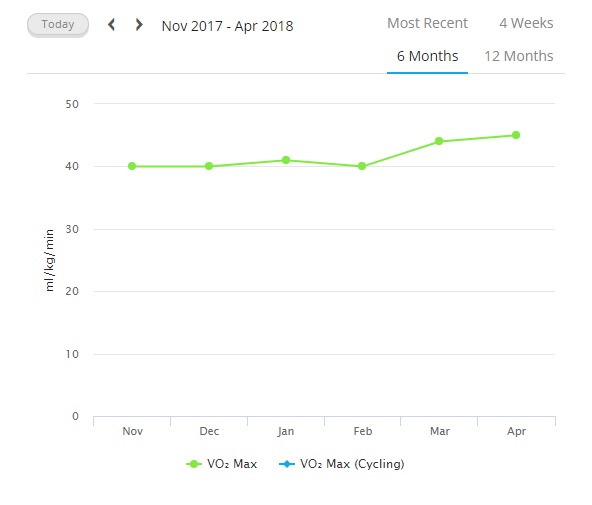
Recent VO2max trend

VO2max Trend (last 6 months)

VO2max Trend last 6 months

    In February, I got a little pain on my left leg and it seemed be a symptom of shin splint.  Therefore I stopped running about a months and just walking and indoor biking (station bike).  It was a middle of a full marathon training (level 1 from Garmin Connect).

   In march I resumed running 7 km every other days.   I have not started any training menu yet and I have not done any high intensity training like "interval training" last 2 months.   Since I was monitoring VO2max and lactate threshold as a factor of training effort.   Here is the recent trend of my VO2max.   (I have not hit to detect lactate threshold last 2 months since no high intensity training).

   Since there is no running in February, my VO2max was dropped in February.   Once I resume running, it is improved month by month.  February value is 40 [ml/kg/min] and the last value is 45 [ml/kg/min].   I just run 7 km every other day (build-up) and I can see a better improvement.  The average pace is improved.  Overall heart rate zone during the training is staying zone 2.

   At least, just running in zoon 2, even I just run 7km with out really high intensity effort, VO2max value is improved.   It shows the key is running regular basis.  I am not sure what my lactate threshold looks like since there is no recent data.  So the next step is to resume some high intensity training once a week.

12/17/2017

Progress of heart rate based training ~ Comparing result in 4 months ago


Doing a training plan in Garmin Connect!

I have been doing training regular basis for Marathon and hiking.   Unfortunately, I got injured in April and stopped training for 6 weeks this year.  Now, my fitness level is getting better after the injury.   I have done "Full Marathon - Level 1" in Garmin Connect from August till November and I started over the same menu December and this week is the third week.

Comparing the result on the same menu....

I compared two different training menu from the third week.  One is "threshold run" and the other is "long run".
Threshold run is warming up for ten minutes and 4 sets of high intensity (heart rate zone 4) for 4 minutes and resting for 20 seconds.
Long lone is 3 sets of brisk working for 10 minutes and slow jogging for 25 minutes.

Following tables are comparison of the results

 Comparison of threshold run
Lap
Time
December 13, 2017
August 23, 2017
Remark
Distance
Average Pace
Distance
Average Pace
1
10:00
1.40
7:09
1.36
7:20
Warm-up
2
4:00
0.81
4:57
0.70
5:43
High intensity
3
0:20
0.04
8:07
0.04
9:06
Rest
4
4:00
0.75
5:19
0.74
5:24
High intensity
5
0:20
0.04
8:33
0.04
8:36
Rest
6
4:00
0.69
5:45
0.66
6:04
High intensity
7
0:20
0.03
10:49
0.03
12.50
Rest


Comparison of long run


December 16, 2017
August 26, 2017
Distance
13.60
12.73
Total Time
1:48:19
1:46:08
Agerage Pace (min/km)
7:58
8:21


Those distributions of heart rate zones are very similar and they indicates I can run faster with a similar heart rate.  Now I am doing the same training plan and my pace is faster than the previous.  I expects to get more improvement with this menu.

This is a good thing for heart rate based training.

I just wonder if I need to step up to "level 2".  But it seems that the same menu (level 1) would be good for now.  Especially, it is better to stay and getting a small improvement without over training.


12/03/2017

Pace management with heart rate for hiking (2) ~ Heart Rate Zone definition

Heart rate sensor for running

   Regarding a method to define a target heart rate for hiking, I think one of good methods is probably based on heart rate zone.   However, there are a few different way to define heart rate zones and the range of the heart rate zone is vary depending on how it is defined.  For detail, I will plan to publish a kindle book to talk about a method to manage hiking pace with heart rate soon!

   As an example using my data, I am 51 years old now (as of December / 2017).   A typical formula to estimate the maximum heart rate is "220 - age".  Based on this formula estimated maximum heart rate for myself is 169 bpm.   However, based on the past training data, actual maximum heart rate for myself is 178 bpm.

Maximum Heart rate the past 6 months
(Based on the training data)

   If I use this value and calculate the heart rate zone, the value will be different.   To be safe, I assume the target heart rate is "zone 2" which is 60~70%.

  • Based on the formula: 101 ~ 118 bpm
  • Based on the actual value: 107 ~ 125 bpm
   Thus there is some gap around a several bpm between the two different maximum heart rate value.  Also, there is another method with reserved heart rate range which is using actual range of the heart rate.  The formula will be "(maximum HR - resting HR) * xx% + resting HR".   xx% would be 60~70% for zone 2.  We need a resting heart rate value and based on the training data in the past 6 months, my number is 59 bpm.

Resting heart rate in the past 6 months

   The calculated value for zone 2 would be:
  • 130 ~ 142 bpm
   The last method is based on lactate threshold.   The variation is huge depending on how we define the heart rate zone.   Lactate threshold could be estimated the latest running device like Garmin fenix 3 HR.   My number is 165 bpm and zone 2 would be 134 ~ 146 bpm.  (The formula I use is from a web site which is 81% ~ 89% of lactate threshold heart rate)
  • 134 ~ 146 bpm
   This method is higher side result.   If people do a training based on the heart rate, this range needs to be reasonably accurate.   Since the strength of training depends on the heart rate, therefore this value is really key for the training menu.   However, it is not really key to define hiking pace and I believe using lower side might be safer.

   Based on my training experience, 134~147 bpm which is calculated based on lactated threshold value, might be reasonable range for myself.  It is also reasonable result for my past Mt. Whitney hiking.  This is just my opinion and less than 120 bpm for myself is probably too low.  I think we must adjust based on the training / hiking data.

   There might be a couple things to apply this method in general.  One is people who are doing training regular bases and the other is people who are NOT doing training regular bases.   For the next post I will try to write my opinion how we need to think about the target value with the heart rate zones.
(To be continue ....)

11/21/2017

Recovery Time on Garmin Running device

   One of features in newer Garmin running device is "Recovery Time".   fenix 3 HR also has this feature and indicates estimated recovery time from one training.   It is not really clear how it estimate the time.   But I have been using fenix 3 HR for a year and I guess the number is reasonable. 

   I am not sure if it is useful for serious athletes, but I think it is useful for some older people like myself.   I had some experiences to get injured due to some over training in the past.  Therefore it is probably a good indication for such people to have enough recovery time between training.

   Currently, I usually pick a training plan from Garmin Connect and follow the menu.  Therefore, I do not have to worry about the resting time a lot.  As long as the training selection is reasonable, we probably do not have to check this value a lot.   But if people has own plan and see if they have enough recovery time, this feature is useful.

   As an example, in Full-Marathon plan, there are "easy run" which is relatively low intensity training and it usually requires around 24 hours recovery time.  But if the menu is "a long run" or "threshold run" the recovery time is getting longer such as 36 hours to 48 hours in my case depending on how hard I did the training.  After I follow the training plan, I have less problem for the injury due to over training.

   Many running devices from Garmin this feature except really low-end models in their current line up.

11/14/2017

Assessment of Full-Marathon Level 1 Training Plan ~ Using Lactate Threshold

Estimated Lactate Threshold last 12 months


The previous posting is looking into improvement of VO2max after the training menu.  Today, I am looking into Lactate Threshold estimated by Garmin fenix 3 HR.

Above plot is a trend of my estimated lactate threshold last 12 months.  This is very interesting result.  Garmin shows two parameters for the estimated lactate threshold.  One is a heart rate and the other is a pace.   This scale is not very good to show the changes.   However, what we can see is the heart rate (red line) is increasing even if I stopped training from April to June due to the injury.  On the other hand, it is decreasing after I started the  training plan in August.   I thought lactate threshold heart rate would be better if the heart rate is higher.   But the reaction of the number is not really matched with my training.  However, the heart rate value in August is 167 bpm and now (November) is 165 bpm.   Because of scale, the change looks big, but it is only 2 bpm between the two.   So I am not sure if this is really changes or it might be within error range.   But the trend is probably decreasing.

The other factor is a pace.  This trend is link to the training.  April is 5:31/km and August is 6:01/km.  Now (November) is 5:51/km.  The trend is a similar as VO2max.   So that it seems to  be the pace as a sort of a performance number.

Overall, I think the training menu helps to improve my running performance and the features in Garmin fenix 3 HR, which is estimating LT (Lactate Threshold) / VO2max is probably useful to see the improvement of the training.

11/13/2017

Assessment of Full-Marathon Level 1 Training Plan ~ Using VO2max

Estimated VO2max last 12 months

Full Marathon Training Plan Level 1 is almost the end

I started this training plan in August after I recovered an injury in April.  It is 16 week plan and it is in 14th week now.   Since the current running device I am using for my regular running has a feature to estimate VO2max from the training data and I want to know the relationship between the training progress and VO2max number.  The best number last 12 months was 43 [ml/kg/min] in April which is before the injury.  Then I got injured in the end of April and I stopped training about 6 weeks after the injury.   The number was dropped to 38 [ml/kg/min] when I resumed training in June.

Once resumed training the number was slightly getting better.  It was 40 [ml/kg/min] in July.   
The number was dropped to 38 [ml/kg/min] in August again.  There are a couple possible reasons:
  • I took a rest about 10 days due to traveling to Japan in the end of July.
  • I started a training plan from Garmin, Full Marathon Level 1 and the initial menu was probably too easy.
 I think I mentioned the reasons in my past posting.  Now the training plan is in 14th week and the number is 41[ml/kg/min].

Previous history of the estimated VO2max

When I got Garmin fenix 3 HR was October last year.  At that time, I was in a middle of the same training plan Full-Marathon Level 1 from Garmin and the number in October in 2016 was 39 [ml/kg/min].   The plan was completed in December and the number was 41[ml/kg/min].  So that the current number is the same as what I have right now.   After that, I moved to Full-Marathon Level 2 which was January to April in 2017.   Then, I got injured right before Level 2 plan was completed.  The number right before the injury was 43 [ml/kg/min] as I mentioned earlier in this post.

Based on the history of the data, it seems that my VO2max number is improved by the training plan.  Also, as I mentioned in some previous posts, the number is probably linked with the training.

Also, the pace (speed) for a similar running is improved as well, especially "Long Run" which is more than 90 minutes.  In the level 1 menu, the long run is combination of walking and running.  So the overall pace including walking is more than 8 minutes / km in the beginning.  The last 2 long run which is more than 120 minutes were better which is around 7:30 ~ 7:40 / km.

The training plan I picked is heart rate based training and the strength is managed by heart rate zone.  So the pace is not how fast I can run.  It is based on a similar heart rate and how fast I could do.  So 8:00 / km is very slow pace, but if I ran faster, then the heart rate is out of suggested range.   So I have to slow down the pace.  Even the training is after the injury, so far I did not see any injury after the recovery and I believe this is a good method for older people.

The data indicates, once people get injured and stop the workout, then the fitness level is getting lower and it is hard to recover the same as before the injury.   The key for older people like me, it is how we can avoid injury due to over  training.  The big problem is even if I do over  training in a short time, I may be able to do without serious injury.   But it may be a cause of injury for long term.  It is very different from serious athletes.  I think serious athletes may need to do high intensity training to improve the performance, but for general people, it might not be very good idea especially older people like me which is over 50 years old.

Last time I switched to Full-Marathon level 2 after Level.   However, I probably want to continue Level 1 menu after the current plan is end.   Even if I take the same plan, it is based on heart rate to define the strength, therefore, if I follow the instruction, I may still be able to get a right level of training.  Maybe in the beginning, it might be too easy again.  But overall, it might be getting some improvement.  Let's see how it goes.  I will continue to report my data and own analysis.


10/22/2017

Heart Rate base pacing ~ Update

Switch back in early summer
in Mt. Whitney trail

This year, I did not go hiking to Mt. Whitney.  I do not have much update.  However, I found out some additional thoughts based on recent date for my running activities.   Today, I just share what I found recently.

A good heart rate number for hiking?

As I mentioned before hear rate zone around zone 2 and zone 3 would be a good range for hiking based on my past hiking records.  Depending on how we define the heart rate zone, a good range would be 60 ~ 80% of the heart range, which is really wide range  In a reality below middle of zone 3 which is around 75% of the range would be a reasonable.  In my case, the maximum heart rate is about 180 bpm and my resting heart rate is around 60 bpm.  With those data, 75% of the range is is around 150 bpm.   Based on the past experience, this is really reasonable value for me.

Recent Running training
Here is my recent update for my training, due to a large wild fire around Napa / Santa Rosa area, the air condition is getting really  bad last a few weeks.   Schools started no PE outside and I also did not run outside last a few weeks.   I only did station bike indoor to maintain my fitness level.

Due to my age, which is over 50 years old, I realized the fitness level is easily getting worse if I do not do training a several days.   This is obvious my past training records this year with stopping training due to injury and vacation.

This time I have not run outside for 2 weeks and then my estimated VO2max and lactate threshold by Germin running device was getting worst a little even if I was doing station bike a few times a week.
Muscle for running is different from station bike and load to my body for station bike is much lower than running.  I found out that my heart rate is really easy to get high within a short period.  The estimated lactate threshold is around 165 bpm by a Garmin device.  However, I probably need to keep it below 155 bpm if I need to run more than 1 hour.  In my case, there is no problem since I set my running pace based on the lactate threshold and 155 bpm is in zone 2 with lactate threshold heart rate.  (155 bpm is zone 3 with reserved heart rate zone and zone 4 with a ration of maximum heart rate.

This weekend, the scheduled menu was 3 times of 55 minutes running with 5 minutes resting (walking) .  I could not have enough time for 3 times and I just did 2.5 times with total time 2 hours 20 minutes.  I maintained my heart rate between 140 and 155 bpm.  The average speed was 8:45/km and the average heart rate was 149 bpm.  This is very slow but this is what I can do now.  This value including 5 minutes working in the activities.  Therefore actual running speed and heart rate could be a little better.  (I did not have a separate lap data this time)

A generic target

In my case, I already have a good target heart rate based on my past data.  I have no problem to manage my pace with that number.  On the other hand, it might be heard to define a generic guide line for other people since 150~155 bpm in my case is could be zone 2 ~ zone 4 depending how I define the heart rate zone.
The key point is where the lactate threshold heart late is in.  If you have high end running device which can estimate a lactate threshold, then the number would be a good reference for the target.  People just need to know how much lower they can set as a target.  If people has less training, then it could be better to set 6~10% lower than the lactate threshold.  If people are in a good shape, then it could be enough to set a few percent lower than the lactate threshold based on my past data.

If you do not have any idea where the lactate threshold is, this could apply based on the training activities.   A rough guide line could be using zone 2 if people do not have much training  and using zone 3 if people has a regular base aerobic training (at least more than 1 hour once a week).
Anyway, zone 2 could be a good range for "easy hiking" in general in my opinion.   The definition of heart rate zone could be good using a ratio of the maximum heart rate (220 - age) I think.  In any cases, important things is to collect more data during your training / hiking to understand your heart rate reaction during activities.

I published a Japanese version of book about the heart rate based pacing method for hiking.  I am still working on an English edition.  It will take some time to translate to English and it is not easy job for me....... 

10/07/2017

Resting heart rate - Usage of Garmin fenix 3 HR

Heart rate trend on Sep 26

   Today's topic is a resting heart rate.  Previously, before I got a Garmin device which can monitor my heart rate 24/7, I used to check my heart rate right after I wake up.  Recently my Garmin device can monitor my heart rate 24/7 and it is easy to tell my resting heart rate.

   Based on the data, my resting heart rate is roughly 50~60 bpm.  This is also depending on a training progress.  If I stopped the training for a while, the number was going up.  On the other hand, when my training progress was getting good, then the number was going down.  The training I am talking here is an aerobic training.

   The other thing I found out recently is the number after a hard training or when I felt tired, then the resting heart rate is relatively higher.  The data I showed in the beginning is a heart rate trend on September 26 this year.   The resting heart rate right before waking up is about 52 bpm.   I also did an interval training after work.  That is why the heart rate in the evening is getting higher.

Heart rate trend on Sep 27

   The next day, the resting heart rate before waking up is 58 bpm.  The difference is small, but I can see a similar trend in the past.  The resting heart rate is usually higher if I have a hard training a day before.  Probably it is due to my age, I usually feel tired if I do a hard training a day before.  I guess the data for younger people might be different from what I see myself.   However, for my age, I guess it is probably better to take a reasonable resting to recover after a hard training.

   I expected to get a similar data on high altitude during a hiking like 14,000 feet elevation.  However, as I posted I could not go hiking this year and collecting / analyzing the data will be after next year.....   This would be an interesting data to understand my body reaction in high altitude!

10/03/2017

Mt. Whitney Hiking 2017 (12) ~ Decided not to go this year ....

Mt. Whitney Trail ~ Fall in 2012

Based on my original plan, I had planned to hike Mt. Whitney last weekend.  However there were many activities for our kids during the weekend and I could not make it happen.  Therefore, I won’t go hiking to Mt. Whitney this year.
It is getting cold, but there might be still good condition in October.   However, there might be a chance to get snowing anytime, actually it was snowing already…   So people who still want to be there need to prepare well for snowing and cold weather.
Regarding my training for this hiking, I am doing a training plan for “full marathon”.  Due to some minor injury I stopped training a several weeks in early summer.   However, the last several weeks, I am getting recovered and it would be a good shape for this hiking.   I was planning to be there till last minutes.
As you can see my last a few posting about VO2max / Lactate Threshold from Garmin Running device, the value shows my improvement last a few weeks.   I think it is a good idea to use a full marathon plan for this long hiking.   It is probably better to run some hill route at least once or twice a week to train muscles for ascending.   Just running on a flat route might not be enough for this hiking in my opinion.
Lactate Threshold for Running last 6 mounths


VO2 max last 6 months

VO2max is recovered to 40 [ml/kg/min] (This year’s max was ‘43’).  Lactate Threshold is 166bpm/around 6 minutes / km.   As I mentioned in the previous posting, the early part of this training plan is a little easy for me and value was drop a little in the beginning.   However, it is getting enough intensity last a few weeks and my number is getting improved.   This data shows probably 3 ~ 4 times a week with one intensive training and one long distance (time) running would be a good plan for hiking.

I will continue this type of training to maintain my fitness level for hiking next year.

9/08/2017

Garmin fenix HR feature ~ Estimating Lactate Threshold / VO2max

Lactate Threshold Pace (Last 6 months)

Lactate Threshold HR (Last 6 months)

VO2max (Last 6 months)

Lactate Threshold Estimation on Garmin High-End Running device

   The last posting was talking about VO2 max for a factor of training progress.  Garmin started supporting this estimating feature most of running devices (above Forerunner 35).   My device, fenix 3 HR, supports to estimate Lactate Threshold (LT) as well.

   The devices shows LT with LT Heart rate and LT pace.   I did not have very good idea how I use the both data.  I did not have enough data to talk about my analysis before.  Now I have probably enough data to talk about LT feature.  As I explained my training activities last 6 months in my previous posting:

  • April: Just finished "Full marathon level 2" training -- Good fitness condition
  • May:  Due to injury late in April, I stopped running about 4 weeks
  • June:  Resumed training, but stopped again due to FRU for 3 weeks
  • July:   Resumed training, every other days 5km - 10km, rested for 1 week in the last week
  • August - September: Started "Full marathon level 1", 3 times a week
  • September -- my health condition is not very well last a several days

   Since last a several days in September, my health condition has not been very well, but I did not take a rest.  Therefore, my performance was not very well.  That is why I do see most of factors are dropped in September.

LT Heart Rate

   The range of LT Heart rate last 6 months is 163-167 [bpm].  The delta between the minimum and the maximum is only 4 [bpm].   My opinion, this is not much difference, but I think slightly improved due to the training a little.  Even if I stopped training, it was not really getting worse.  As long as I tried to do something regular basis, this might not change a lot.  Maybe people who does not have training for a long time, it may be improved with some regular based training.

LT Pace

   The range of LT pace last 6 months is 5:31 ~ 6:23 [MM:SS].   The delta is close to 1 minute.  If I stopped the training, the number was getting worse and once I resumed running, it was getting better slowly.  The trend is very similar as VO2max.

My analysis

   I think LT HR is probably not much change as long as people continue to training for long time and LT Pace and VO2max could be a good factor to see the progress.  Either one could be used to measure the progress of the training.  Many models support VO2max estimation, but LT estimation is limited only some high-end model.   The high-end models have more nice features and the prices is much higher than other low-mid class models.   So if you just need a basic features, I think Forerunner 35/235 would be good.   Also 735 price is getting lower due to some other new models.

   The other factors, VO2max estimates works with the embedded heart rate sensor.  However for LT estimation, chest-strap heart rate sensor is requires.   Also, to estimate LT, people need to do relatively hard workout than VO2max estimation.  VO2 max estimation can be done with a light workout.  I am not sure how it is accurate.  But even I ran slowly, the value is a similar number as I did heard work out.   So with those factors, I would think VO2 max is probably more convenient in my opinion.


7/08/2017

Garmin fenix 3 HR ~ 24 hour heart rate monitor


Trend of resting heart rate last 12 months

   The recent running watches and activity trackers from Garmin have embedded optical heart rate sensor and monitor heart rate 24/7 other than activities.  Some of high-end models has a feature to estimate stress factor, but those daily heart rate trend helps to understand the health condition.

   Anyway, the key is having / accumulating data over time as a history.   The the trend shows rough health condition.   The first plot shows the last 12 months average resting heart rate.   The late last year, the average was less than 60 bpm.  However the trend is increasing the resting heart rate.  This is probably because the time I spent for training is getting less due to injury, flu, weather (more rainy day) and expiring a membership of a fitness club.  Nowadays, my average resting heart rate is between 60 bpm and 70 bpm.


Data for last 4 weeks

   Those are clear if we see data with last 4 weeks data.   After recovering from FRU, I resume running about 2 weeks ago (June 24th), the period I took a rest, the trend is increasing the resting heart rate.   However once I resume running, the trend is decreasing the resting heart rate.   I can see a similar trend with other time.  So this is not only data, but also I do see a similar trend in a similar situation.

Last 7 days data

   Further more, based on data last 7 days, a day after a hard training, the resting heart rate is usually getting higher.  Also, if my sleeping time is less than usual, then it is also getting higher.  This is also not only this period, but I do see a similar trend in other time.   It seems that it is getting higher when I feel tired, feeling bad and etc for me.   I think the data shows if I have less sleeping, then the resting hart rate is getting higher.


A daily data

   Here is an example of a daily data.   It seems that the heart late getting lower slowly during sleeping.   If I do not have enough sleeping time, the heart late might not get lowest point since getting up and start moving for a daily life.   Also, if I sleep longer like weekend, then the resting hart rate is saturated and almost constant value after a point.  This is probably explain why many people says people need to have enough sleeping to recover.   In my case around 7 ~ 8 hours sleeping to get the lowest resting heart rate.  If I sleep more, the resting heart rate is almost constant.  So I probably need around 7 hour sleeping to have enough rest / recovery daily.

  As I mentioned a couple times in posting about heart rate base pace management during hiking.  I am really interested in my heart rate when I sleep in higher elevation such as Mt. Whitney.   In my case, I know my trend in camping in a regular elevation where is a similar as our daily life is similar as I sleep at home.   So I want to know how it changes in higher elevation.

   This is one of area to have a latest "smart watch" with embedded heart rate sensor.  It is a good tool to understand my health situation.


6/26/2017

An example of usatg for Garmin fenix 3 HR ~ Estimation of Lactate Threshold


Lactate Threshold on Garmin Connect

   The previous posting was beginning of June, so that it's been for a while.   After the injury was getting better, I just resumed running, however, I got really bad flu and I stopped running for 3 weeks due to the flu.
   I am not fully recoverd, but I resumed running last Saturday.  I ran for 90 minutes, but the pace was really slow and I only ran 11 km.   Then, I was pointing about function of Garmin fenix 3 HR, I keep my eyes on the VO2max and Lactate threshold estimated by the device.  For VO2max, as I reported, the number was dropped to 36 [ml/kg/min] and a little recovered to 39[ml/kg/min] after I resumed running late last month.  After 3 weeks of resting, it was dropped to 38[ml/kg/min].  Probably, the ratio of dropping was slowing down and even if I rested for 3 weeks, the actual dropping is very minimum.
   However, the lactate threshold is a bit different.  The Garmin device provides 2 numbers, one is heart rate and the other is pace.  I am not really sure what the relationship for those 2 numbers.  Based on my recent data, the heart rate value is almost the same which is around 164[bpm], however the pace is slowly dropping.   It was 5:40/km in March, but now it is dropped to 6:28/km.  It is about 1 minute dropping.  Actually, I felt my breath is getting higher than before even with slower pace.  The number is probably indicates that situation.   To see my training progress, it is probably good to monitor those 2 numbers, VO2max and Lactate threshold especially the pace.  I will post how those numbers get improved.

   Before the injury, I had done a level 2 of full marathon menu.  But I guess it is better to back to level 1 after a few weeks of slow jog.   I am thinking to run every other days since I just resumed running after flu.

6/01/2017

Mt. Whitney Hiking 2017 (9) ~ Training using Garmin fenix 3 HR

VO2max value is recovering

   As I mentioned in a different topic, I got injured my right leg and I just resumed running about two weeks ago.  This is a training not only for a marathon, but also for hiking to Mt. Whitney as well.  Running is one of a good training to improve my aerobic performance for hiking.

   Due to the injury, I stopped running for a month and my VO2max value is down from 43 to 36 [ml/kg/min].  This drop is significant performance down.   After 2 weeks of running, the number is getting better and it is 39 [ml/kg/min].   The first 5 days, I only ran 2 miles, then increased to 3 miles and this week is about 4.5 miles.   The average pace is also getting improved.
   Since I just resumed running, I tried not to run fast.   I tried to stay "slow pace", but the course selection, I tried to include some hilly sections.  This will helps to train muscle for ascending.   I think this VO2max is one of good factor to monitor my training progress.  At least I can tell my training is on track to recover from the injury.

Lactate Threshold

   On the other hand, the lactate threshold is not improved like VO2max.   However, I tried not to run faster.  Therefore, once my body is adopted for the pace.  I might not reach a point fenix 3 HR cannot detect "lactate threshold"  because the pace is not fast enough to hit the threshold.   This is probably true.  Because right after resumed running, my heart rate jumped close to my maximum heart rate value.   However the heart rate is getting stable with the current slow running pace after 1 week.

  I will monitor those two factors as index of my training progress.

Resting

   Another factor, I do care now is resting.  Since I just resumed running and I am not young any more.   I try to take more rest day than usual to avoid another injury.   So my current training schedule is 2 day running and 1 day resting.   Then I try to increase total running time slowly.   I think this is a key to avoid injury, especially people who have not been training for a while.  My first goal is try to recover my VO2max to more than 40 [ml/kg/min] first.  Then I will resume more speed (threshold running) to improve my fitness performance.


5/23/2017

An example of usage for Garmin fenix 3 HR ~ VO2max and Lactate Threshold

   Garmin announced some new running watches recently.  However, I just replace my running watch from Forerunner 910 XT to fenix 3 HR about 6 mounts ago.  It is good enough for me for now.   Today, I introduce one of my usage of fenix 3 HR.  There are functions to estimate my VO2max and Lactate threshold.  This function is not supported in Forerunner 910XT.

   As I posted before, I went to Taiwan last month.  The second day, I resumed running over there.  However I got injured during the training.   I tipped and tried to recover.  However, my right leg got some unexpected force and probably my muscle got injured.  Due to the injury, I stopped running since April 17 till Wednesday last week.  It's been a month.  The first week was really bad.   I had really bad pain even if just walking.   It did not happen when I was young at least 5 years ago.   I guess my body is not strong like before due to aging.


My leg right after the injury
(you can see internal bleeding)

   Because of the injury, I stopped running for a month.   I still feel something strange on my left leg, but I resumed running since last Wednesday with really slow jog around 3km.

   Then one of interesting function in fenix 3 is estimating VO2max and Lactate Threshold.  Those functions are supported in "fenix 3 HR" and newer high-end model.  Many running watches from Garmin supported VO2max, but supporting Lactate threshold function is still limited to the high-end models.


VO2max last 6 months

   Here is the trend of my VO2max.  Before the injury, it was around 43[ml/kg/min].  But after resuming running, it was dropped to 36[ml/kg/min].   Previous trend was staying more than 40, but just stopped running for a months, the number is significantly dropped.

 
Lactate Threshold (Heart rate / pace)

   The next plot is Lactate threshold.  The heart rate was slowly up from 160[bpm] and the value right before the injury was 163[bpm].   After resumed, it was slightly dropped to 162[bpm].  The pace was 5 minutes 30 seconds / km right before the injury.  Then, it was dripped to 5 minutes 47 seconds / km.  For this trend, I guess it might be hard to conclude the performance is getting worth.   But I think a little performance drop could be true.
   The both value has not been improved in 5 days.  At least VO2max is significant drop after the injury.

   Anyway, after age 50, the performance drop due to no training is getting bigger than at least 5 years ago (age 45).   Thinking about the fact, to keep a good performance, the best way is not get injured.  What I watch next a couple months will be checking the both value how I can improve the performance getting back before the injury, especially how long I need to take.  This date is probably very interested in how my training help to improve the performance.  Showing a number is a good scale to tell my performance and the result of the training.   I think it is very good feature to motivate daily training and monitor the progress.

(To be continue)

12/21/2016

Garmin fenix 3 HR ~ A feature to estimate Lactate Threshold

Lactate Threshold last 3 months


   Another new feature in Garmin fenix 3 HR is estimating the lactate threshold.  This feature only supported a several high-end device, such as fenix 3 series, Forerunner 735XT, 920XT and 630.   There are two modes to estimate the lactate threshold.  One is guided testing and auto mode.  I have not tried the guided testing, but as long as users do high intensity training which is close to the maximum heart rate, the device automatically estimates the lactate threshold.   If the activities are not high-intensity enough, then the device won’t do anything.   To estimate the lactate threshold, the device needs to know the VO2max value.

   Based on the past activities, as long as an activity is in heart rate zone 4 / 5, the device will estimate the lactate threshold after the activities.  The device shows the heart rate / pace at the lactate threshold for running activities.  This device also support lactate threshold for cycling independently.  However I have not tried cycling with this device yet.

   The plot showed in the beginning is my result last 6 months, actually last 3 mounts since I got fenix 3 HR.   The initial value was 154bpm@5’37”/km.  The last one is 160bpm@5’28”/km.   During the period, I have been following a training plan “Full marathon level 1” from Garmin connect since early September.   The plan has a threshold running which is high intensity training once a week.   It seems the LT (heart rate / pace) is improving.   I have never measured actual lactate threshold in a lab, therefore, I cannot tell the value the device estimated is close to the real value or not.   However, it is a god index to see the progress or the training.   At least I do see some improvement and it is a good motivation to realize the progress of a training other than the personal records for some distance.   Also the estimated value is probably close to my real value based on the past training and hiking records.

   This feature is only available some selected devices from Garmin and most of models which support this feature is typically expensive.   However, this is a nice feature to see the progress some other parameter other than the pace / time.   Overall, I am happy to upgrade my running device and having some nice feature from the recent technology.