11/10/2016

Garmin fenix 3 HR ~ as a daily watch


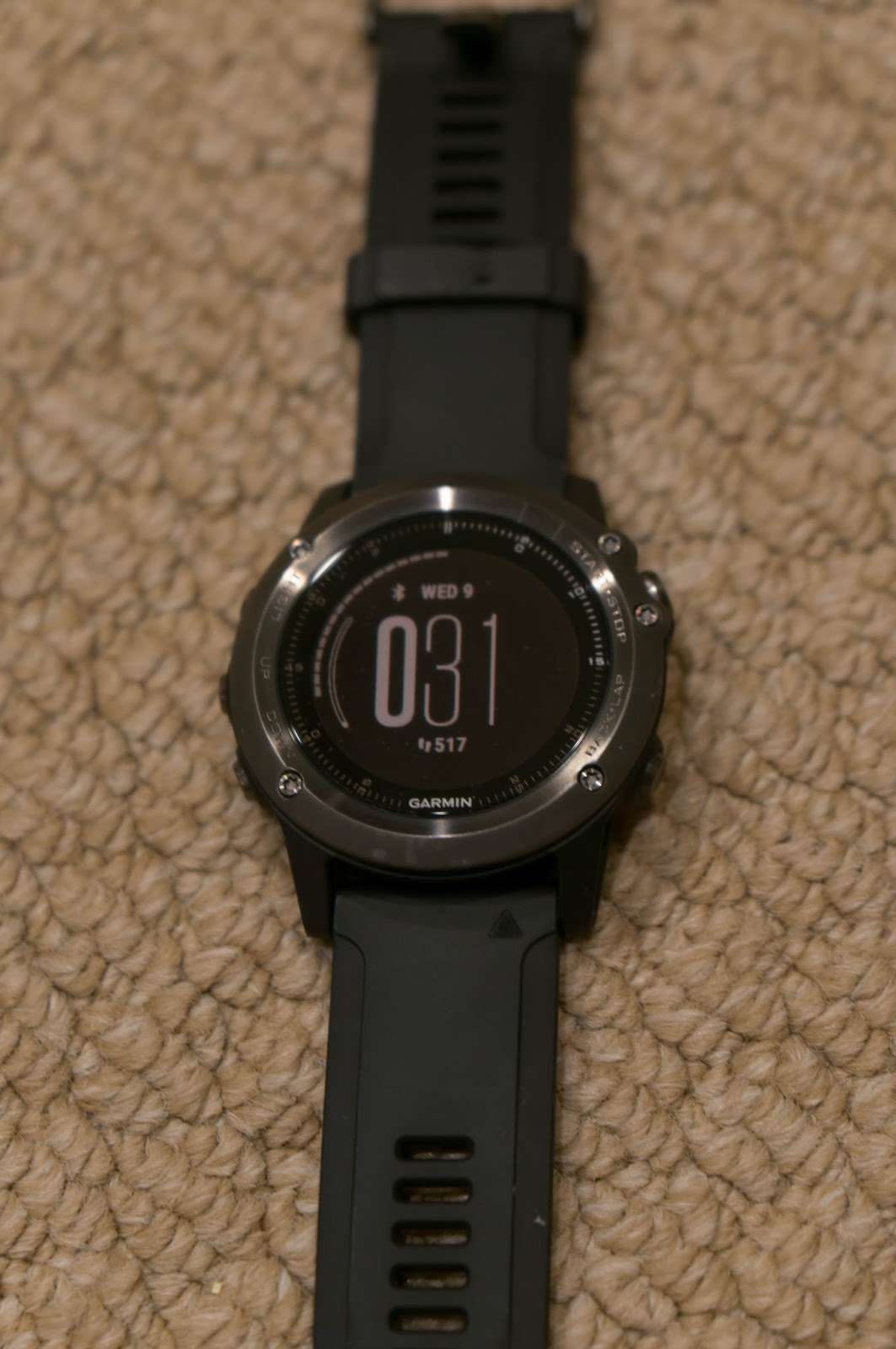
Standard digital watch face

As a daily watch

   First of all, I am writing my first impression as a daily watch.
   This device has standard watch faces, which are a digital face and a analog face.  Many of photos for fenix 3 HR are the standard digital watch face.  However, there is an analog watch face as well.

Standard analog watch face

    The standard analog watch face is a simple one.

Garmin Connect IQ

   The next thing is Garmin Connect IQ, which support to customize the watch face, application, a gadget with downloading customized one.   I have not tried other than a watch face, But it is nice to customize the watch face with what you like from the store.

 Customized watch face in Garmin Connect IQ

   Personally, I prefer an analog watch face.  I download one above from the store.  It looks like chronograph watch.  The actual design includes to show altitude, remaining battery and steps.  The old generations are not really stylish, they were just a gear for activities.   The latest model is getting nicer and it looks like a regular watch.   With changing band, I think it can fit as an accessory most of occasions.

  Forerunner 910XT which is the one I have been using  is not very good as a daily watch due to the battery and GPS mode, it is not really designed for that usage.  Thus, I feel like this is getting much more convenient for me.

Physical dimension and the weight

   Before getting it, I thought it seemed that the physical dimension and the weight could be too much.   However, in a reality, the physical dimension is a similar as Forerunner 910XT with a little extra weight,  I do not feel that it is too big even if I am running.  It is actually better for me to read the data field with presbyopia.

   Even if I wear it 24/7, it is not a big problem to monitor my heart rate 24/7.   I think it is a good product for a daily use.

11/08/2016

Garmin fenix 3 HR ~ got it!

Got it!
   I had been comparing GPS watch from Garmin in the past weeks.  Finally,  I got a new GPS watch, Garmin "fenix 3 HR".  I will post reports for this new watch based on my experience.

   Today, I do not have much item I can share.  I just did charge it.  From almost empty to full, it took more than 2 hours.   It was longer than what I originally thought.  The first thing I want to check is how long I can use it.  Based on the specification, it will be around 16 hours with GPS mode, 2 weeks with a smart watch mode.  My typical usage will be 3 days (times), total 3 hours for outdoor running and 3 days (times), total 3 hours in a gym cardio training.  My guess would be around 7 to 10 days .   I will report about the battery life as the first topic.

11/04/2016

GPS Watch selection in 2016 fall ~ my selection!

I've been using this for almost 4 years ....
   Although my current GPS watch Forerunner is still working well, I am considering to get a new one based on the test result of the built-in heart rate sensor in vivosmart HR and some advanced feature in the new product line.
   I was talking about a generic points in the previous posts, today, I am writing more my personal expectation.

My usage? 

   First of all, I list my usage and requirements:
  • Running including a daily training and races
  • Prefer to download training plans on a calendar on Garmin Connect
  • The race is probably up to full marathon and based on my performance level, it is probably around 5 hours
  • Daily activity tracing especially monitoring heart rate 24/7
  • Hiking, but I probably won't try very long day hiking
  • The maximum walking time a day would be up to 10 hours such as going back to the trail head after Mt. Whitney summit attempt from Trail Camp
  • Want to have built-in wrist based heart rate sensor to get my heart rate data during sleeping in Mt . Whitney hiking.
  • Interested in getting extra running dynamics data
  • Interested in a feature to estimate lactic threshold and maybe VOmax extimate as well
   Due to the second item which is downloading the training plan, Forerunner 35, vivoactive HR and vivosmart HR+ are out of my selection.  They cannot support the feature.  Also, to meet the other expectations, the candidates are Forerunner 735XT or Fenix 3 HR.

Which one would be good for me?

   The both of them meet my expectation.   Forerunner 735XT is lighter than Fenix 3 HR.  The weight of Forerunner 735XT is about half of Fenix 3 HR.   However the battery capacity of Fenix 3 HR is larger than the Forerunner 735XT.  Fenix 3 HR has an altimeter and a compass.  Fenix 3 HR also looks better.  The price of Fenix 3 HR is about USD $150 more expensive than the Forerunner 735XT.
   It is really depending on person's preference and the price.
   I prefer Fenix 3 HR because of a better outlook as day-to-day watch and larger battery capacity.   I am not sure if I really use the altimeter and compass, but they are nice to have.  I plan to get Fenix 3 HR and do some testing.

11/03/2016

GPS Watch selection in 2016 Fall ~ other usage?

for running?


GLONASS ~ Russian version of GPS

   If people want to use it just for hiking, I guess a reasonable battery capacity and built-in heart rate sensor would be enough.   Some of recent models can support GLONASS, which is Russian version of GPS, other than GPS.  In a reality, as long as a device supports GPS, then I do not believe we have issues.  All GPS devices currently I own, I have never seen any problem at all.  So, in my opinion, I do not think this is a big factor to select a GPS device.  It is just nice to have it.

Other sport usage?

    Just thinking about other sport usage, I guess it might be different selection depending on people do other sports, especially, if people want to use it for swimming / triathlon, the selection would be limited from Gamrin product line.  Any model does not support the built-in heart rate sensor during swimming.  But those models which support swimming would be able to monitor the heart rate with a special chest strap based heart rate sensors.   The models which can support the special heart rate sensor would be Forerunner 735XT and Fenix 3 HR.   Vivoactive HR also can support swimming, but the function is very limited.  I do not swim much, therefore, I do not have much idea in detail for swimming.
   The other major sport is running.   If people just want to log where they run, then any model would be all right.  There is a nice feature that people can download a custom training menu from Garmin Connect website in some models.  Also, some of models can estimate VOmax, Lactic threshold and capture some additional running dynamics and etc.   My current device, which is Forerunner 910XT, only have a feature to download the custom training menu.  The rest of the advanced features are not supported.
   If people are interested in following the training plan on Garmin Connect, the feature to download the menu is really convenient.  The device can provide the instruction and manage the time / heart rate.  Once people get used to do, it is really nice feature.   If people are not interested in the training plan or put a custom training to the device, it probably does not really matter.   Forerunner 35 / 235 only can support a simple interval training on the device.  I think it is probably all right for most of people.
   The rest of features are probably nice to have.   People can estimate VOmax with Cooper testing (12 minutes running).  Based on the distance people can run, people can tell their VOmax value from a chart.   To estimate lactic threshold is a bit harder, people might need to take a test or guess from their training data.  In my case, I really like to get extra data to analyze them to understand my fitness in different angles.

For Golf

   Fenix 3 HR and vivoactive HR supports a function for golf.   They can get course data to the device and find out the distance from the ball location to the green.  I do not play golf a lot and I am not really interested in the feature.  But it seems to be a convenient feature for golf lovers.

For outdoor sports

   Fenix 3 HR and vivoactive HR has many outdoor related features.  They are probably nice to have, but I do not believe they are really necessary.  The pressure based altitude meter and compass are convenient, but I really do not really care if a devise have a feature or not.   I may carry them independently if I really need.  They are just nice to have. 

The rest ….

   The rest of features are probably dimension, weight, price and outlook. They are really depending on each person.  Everybody has different expectation / taste and it is hard to say what would be a good one.  Just a personal opinion, Fenix 3 HR looks nice like a regular watch.  On the other hand, it is big / bulky and some people feel it might be too big.  In my case, I have been using Forerunner 910XT for a while, it is a big and I really do not feel like too big.   The other concern could be it is a bit expensive.   Regarding the dimension, Forerunner 35 is a small one, but the other one could be a similar size especially the display.   Fenix 3 HR is more than 80g which is almost double of Forerunner 235 / 735XT.  It really depends how people think / feel about the dimension / weight.
   For me, I am getting old and a big display help me that it is easy to read …..  This is another good thing for a big display.


10/31/2016

GPS watch selection in 2016 Fall ~ Built-in heart rate sensor and battery capacity

Built-in heart rate sensor on vivosmart HR

   I will go over some points to select a GPS watch in 2016 fall.


 For hiking

   It is obvious that there are many different GPS watch from many manufacturers, for running and etc.   Each manufacture has a target customer for each model.  Therefore, the selection can be so many.
   I will focus on using it to manage walking pace based on the heart rate in hiking based on some posts in this blog. 


Benefit for built-in heart rate sensor!

   I tested the built-in wrist based heart rate sensor recently.  As a result, I would think it is good enough for hiking.   I think it is a big benefit not to wear the chest strap sensor during hiking.
   There were a couple experience in the past:
  • It was easy to move when I shoulder / unshoulder backpack.
  • I got some scratch due to the sensor was rubbed during hiking for a long time
  • I forgot to bring the chest strap sensor to hiking
   With the built-in sensor we could eliminate them and it is a big benefit in my opinion.
   The other pulse is we can monitor the heart rate 24/7 for most of devices with built-in sensor.  I do not have a good example to have such data.  But there are some interesting data such as heart rate data during sleeping in high altitude something more than 4,000m elevation.  I want to see if there is any indication related the altitude.  

   With those reasons, I prefer to get one with built-in heart rate sensor if I buy a new GPS watch for hiking.

Manufacture selection

   If you already have a GPS watch, I would think you have some tracking data already.  In this case, I guess you want to get one from the same manufacture as your first choice.   However, if you buy it for the first time, you might not have any preference for your selection and you have so many choices from various manufactures.
   In my case, I have been using Gamin GPS products and I do not have much experience to use other manufacture's devices.   Since basic function is almost the same and I do not have any plan to switch the manufacture.   Therefore, I will pick one from Gamin products.   Thus, the selection is very limited. 

Candidates?

   Based on the condition, I will list possible devices from Gamin as of October 2016:
  •  vivosmart HR+
  • Forerunner 35
  • vivoactive HR
  • Forerunner 235
  • Forerunner 735 XT
  • Fenix 3HR
They are the one which has built-in heart rate sensor.

How can we pick one?

   As a next step, how we can narrow down the selection.  First of all, I would think the battery capacity how long we can use the device with GPS mode.  It really depends on how long people typically hike.
   For example, if people usually go hiking up to a few hours in local area.  It might not have much limitation.  People can pick almost any devices since most of them can support the time for cut-off time for full marathon which is usually around 6 hours.
   On the other hand, if people do hiking full day, they need to be careful.   For example, vivosmart HR+ in the list above, it is up to 8 hours with the GPS mode.   This is the time fully charged condition.  Based on my past experience, the time is usually getting short by time being.  If people do a full day hiking, I would think it is better to have more than 10 hours in its specification.  If people consider really long day trip such as a day trip to Mt. Whitney trail.  I think most of people need to take more than 12 hours.  So that it is better to pick a bit longer than 12 hours.  Then, the possible selection would be very limited.

   I my case, I do not think I will do very long day hiking.  Probably the longest is around 10 hours, something like going back to the trail head after summit attempt to Mt. Whitney in Mt. Whitney trail.  For this purpose, I would think more than 12 hours would be good.
    Then, I can eliminate vivosmart HR because it is up to 8 hours in GPS mode.   Forerunner 235 is a border line, it is up to 11 hours.   The rest, Forerunner 35 and vivoactive HR are up to 13 hours, Forerunner 735XT is up to 14 hours and Fenix 3 HR is up to 16 hours.  Forerunner 735XT and Fenix 3 HR can support "ultra-track" mode, which can use up to 24 hours and 40 hours each.

   Just battery capacitor, if people want to have a low cost solution, Forerunner 35 or vivoactive HR would be good.  If people do not have limitation of the price, Forerunner 75XT and Fenix 3 HR could be a good selection.

(To be continue)
10/27/2016

GPS Watch selection in 2016 Fall

Forerunner 910XT - It is a little out of date ...

   I am suggesting a pace management based on heart rate during hiking in this blog.   As a part of this topic, I have been using "vivosmart HR" to review the built-in wrist based optical heart rate sensor.   As a conclusion, I would think "vivosmart HR" would be one of good options as a low cost solution.

   On the other hand, I have been running regular bases and try to achieve a personal record for a full marathon.   I also keep hiking records with GPS.  Personally, I really wants to have a GPS watch for those purposes.
   Currently, I have been using "Garmin Forerunner 910XT" for running and hiking GPS tracking.  It is almost 4 years old and I have also been using "vivosmart" /  "vivosmart HR" for daily activity tracking.   It works well and I do not see much problems with those devices.  Recently, I started using "vivosmart HR".  It can monitor not only steps, but also heart rate 24/7.  It is very useful to monitor heart rate 24/7 other than just during hiking.   Especially, I realized that the rest heart rate could be getting higher after hard training and my health condition is not well.   They are a sort of known facts, however with my data, I really recognize the fact more and I can think about my health and training with more attention.

   Originally, I was interested in monitoring heart rate during hiking in higher altitude to see how it looks like.  For the purpose, I was really interested in a device with the built-in wrist based heart rate sensor.   Based on what I have now, which are "vivosmart HR" and "Forerunner 910XT".   I can get all data I want to see with those devices.  However if I look into the latest devices, it can be done with a device.
   It is also getting a lot of improvements for collaborating with a smart phone in last a few years.  We do not have to have PC to manage the data any more.  For a high-end model, we can capture some additional data as well.

   With this given situation, I am thinking to get a new device and there will be so many advantages with the latest device.   I am really interested in what would be options with the latest devices in 2016 fall.  Thus, I will post some considerations.


10/21/2016

Garmin heart rate sensor tips!

Chest strap base heart rate sensor


   I have been collecting data to compare the reading offset between Garmin Forerunner 910XT with a chest strap based heart rate sensor and Garmin vivosmart HR with built-in wrist based optical heart rate sensor.  As I posted before, the overall trend is close enough for my usage such as casual running, walking and hiking.  Roughly more than 90% samples are within 4~6 offset.

Chest strap sensor

   As I mentioned in the previous post, I sometimes see inaccurate reading by the chest strap sensor.  In many cases, it shows beginning of a workout.  I also saw a few cases out of twenty workouts after middle of workout.  I think they are probably depends on how I wear the sensor.  Especially the offset in the beginning is probably the sensor might not have a good electrical contact, which might be higher electrical resistance between the sensor and the body.  Once I started sweating, the contact is probably getting better and getting a reasonable reading.  When I saw the offset not in the beginning, I think the sensor could be move / shift during the workout.   I think the chest based sensor is probably good as long as it has good contact to the body in my opinion.  For more accurate measurement, it is probably better to put some moisture when a person wears the sensor.

Wrist based sensor

   First of all, to get a good reading, it seems that we need to wear the device tight enough.  If it is loose, it seems the reading won’t be stable.  This is a similar as the chest based sensor.  The device needs to have a good contact.  Once people understand how tight we need to get the reasonable reading, the result is probably getting better. 
   Based on the past data, I do see two type of inaccurate reading.  One is some higher reading where the heart rate value has a peak.  The maximum heart rate tend to show as higher value than actual.  As long as the reading value is stable and the delta between samples is small, the reading value against the chest sensor is almost matched.
   The other observation is it has some time has a sharp spike.  I do not know why this happens.  But I sometimes see.  The duration is very small and overall heart rete value is stable and no big transition overall.  Just that short period, I do see very high spike.
   Because of those inaccurate reading some time, the maximum heart rate shows higher than the chest based sensor.  I think that is one of reason, Gamin does not offer to estimate VOmax / Lactic threshold by the wrist based sensor.

Conclusion

   Based on the date I collected, the wrist based sensor is totally acceptable for my usage.  People just needs to understand the behavior that it shows a bit higher value sometimes comparing with the chest based sensor.  The both sensor might have error reading, but the chest based sensor reading is much more predictable.  The error reading on the wrist based sensor could be more random and hard to predict in general.   So if the heart rate reading changing a lot, the chance of offsetting could be higher.  As long as the heart rate is stable, it is relatively close to the chest based sensor reading and it is easy to tell if it has some inaccurate reading.
   My opinion, just using the reading value for pacing, the wrist based sensor is all right.   If a workout make higher transition like interval training, it is still useful to use the wrist based sensor, but the chest based sensor can be much stable.  So, I probably continue to use the chest based heart rate sensor for running especially interval and high intensity running.  But I will use the wrist based sensor for hiking and casual running.
   This conclusion is a similar as I concluded in the wrap up for vivosmart HR review.  But with some extra data, I might have a better explanation for the offsetting.
   So far, the wrist based sensor is probably a good option for many people.

Side note:

   The battery life for the broadcast mode is probably around 20 hours.  So it is long enough for tracking the heart rate with broadcast mode to the other device during hiking.